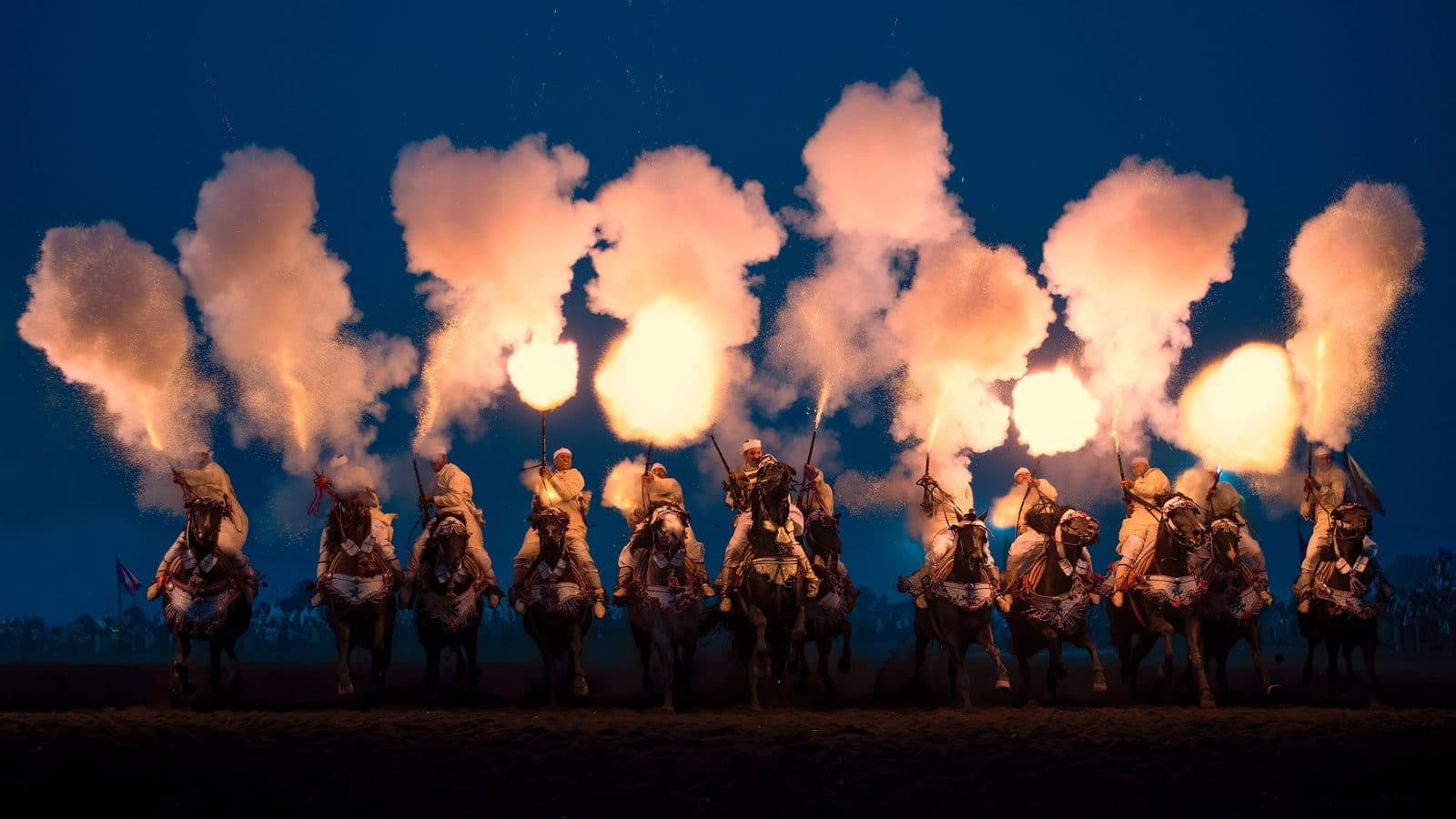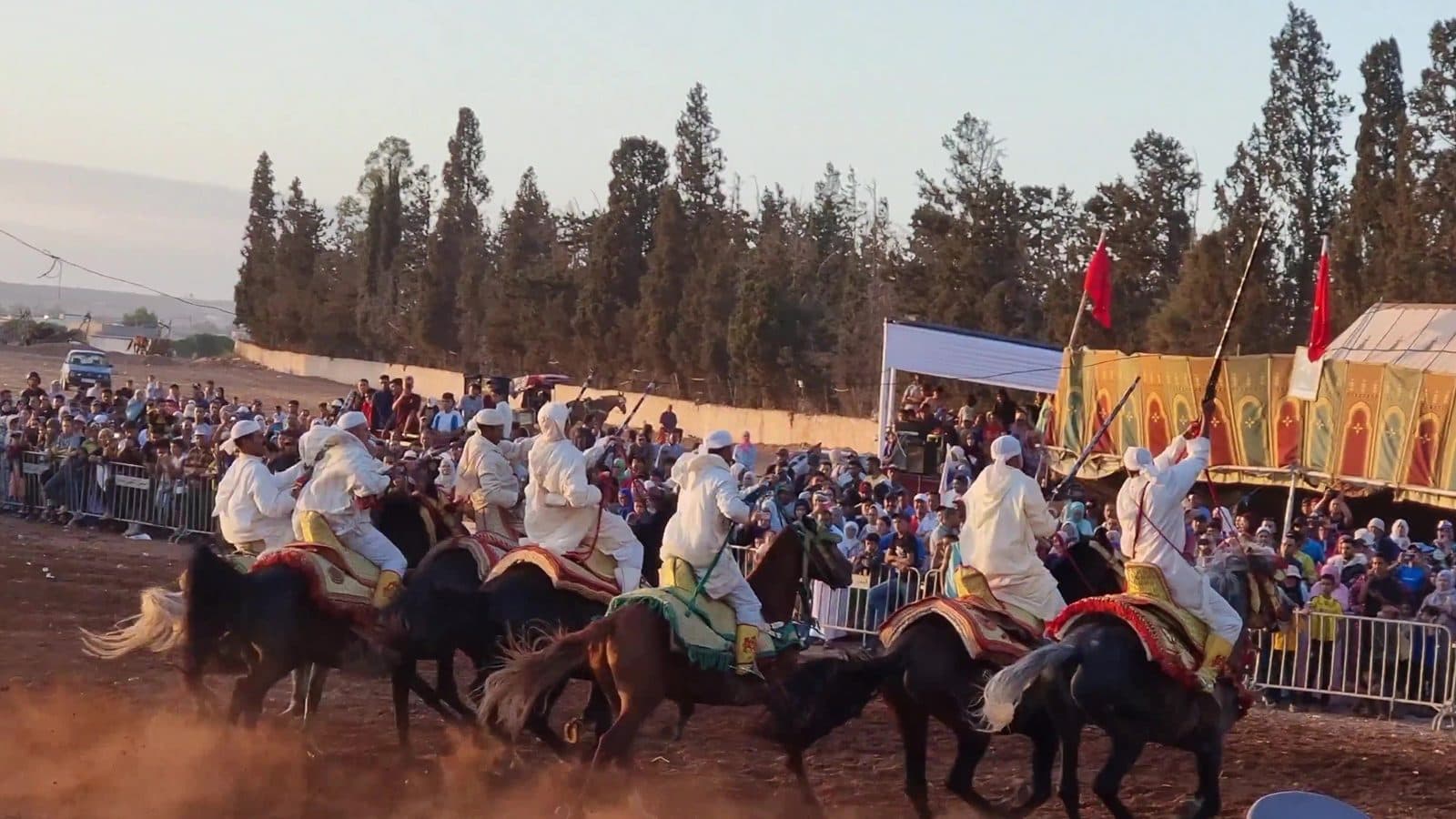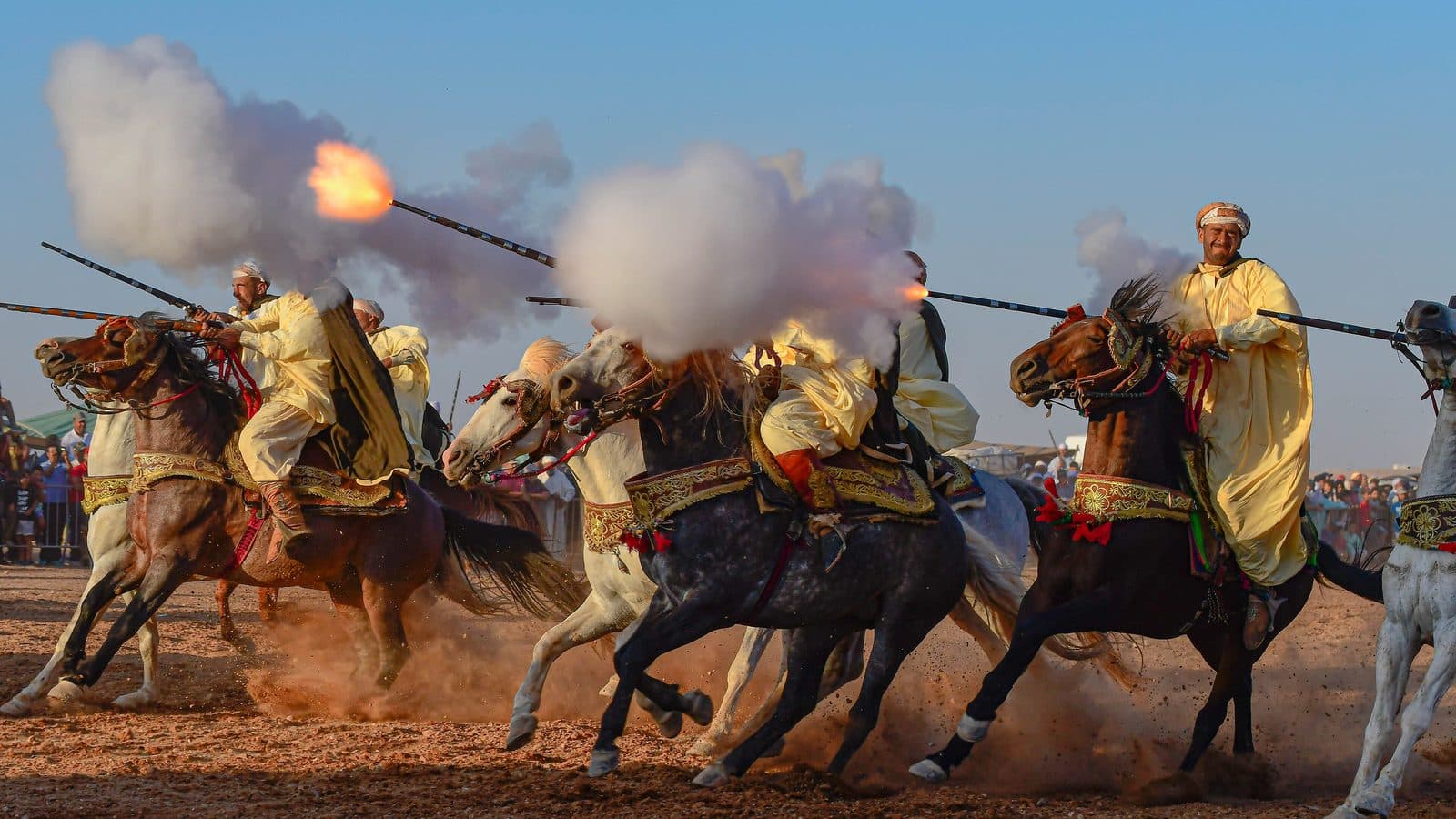
The first time you watch a tbourida, it looks like controlled chaos: horses explode from a standing start, riders shout, rifles flash and a wall of smoke rolls over the track. The second time, you start to notice the details — the straight line, the raised rifles, the instant of the shot — and you understand why the crowd cheers some charges and groans at others.
This guide explains the vocabulary and the rules, so that you know exactly what you are watching at a moussem or a fantasia show. For the history and where to see one, start with our complete guide to the Moroccan fantasia.
Tbourida: what the word means
Tbourida comes from baroud, the Arabic word for gunpowder. Foreigners usually call it fantasia, a name popularised by 19th-century European painters. Both describe the same thing: a team of horsemen who gallop in a line and fire their muskets together, in memory of the cavalry charges of the past. In 2021 UNESCO inscribed tbourida on the Representative List of the Intangible Cultural Heritage of Humanity.
The sorba: a team, not a soloist
The basic unit of tbourida is the sorba, the troupe. A sorba usually counts between ten and twenty-five riders, often from the same tribe, village or family network. They train together for months, share the same colours and travel together from moussem to moussem with their horses and equipment.
The spirit of the sorba is collective: nobody wants to be the rider who fires a fraction of a second too early or who lets his horse drift out of the line. A good passage is judged on the whole team, never on one rider.
The leader: allam or mokaddem
In the centre of the line rides the leader, called the allam in many regions — the allama when a woman leads — and often referred to as the mokaddem. He or she is usually the most experienced rider. The leader:
- sets the pace of the salute and the moment of departure;
- keeps the line straight during the gallop, by voice and by position;
- gives the cry that tells everyone to fire.
Watch the leader rather than the whole line, and you will understand the rhythm of the charge.
The three moments of a passage
- The salute (hadda). The sorba walks or trots to the start of the mahrak, the earth track that can be two to three hundred metres long. The riders greet the spectators and the officials, often turning their horses and raising their rifles.
- The launch (talqa). At the leader's call, the horses break into a gallop together. The riders hold their rifles high or spin them, while keeping knee to knee with their neighbours.
- The volley. At the leader's cry, everyone fires. In a perfect passage you hear a single detonation and see one cloud of smoke. Then the riders pull up their horses and walk back.
The whole sequence lasts less than a minute. Dozens of sorbas may follow one another during an afternoon, so you will see plenty of attempts — and learn to tell a great one from an average one.
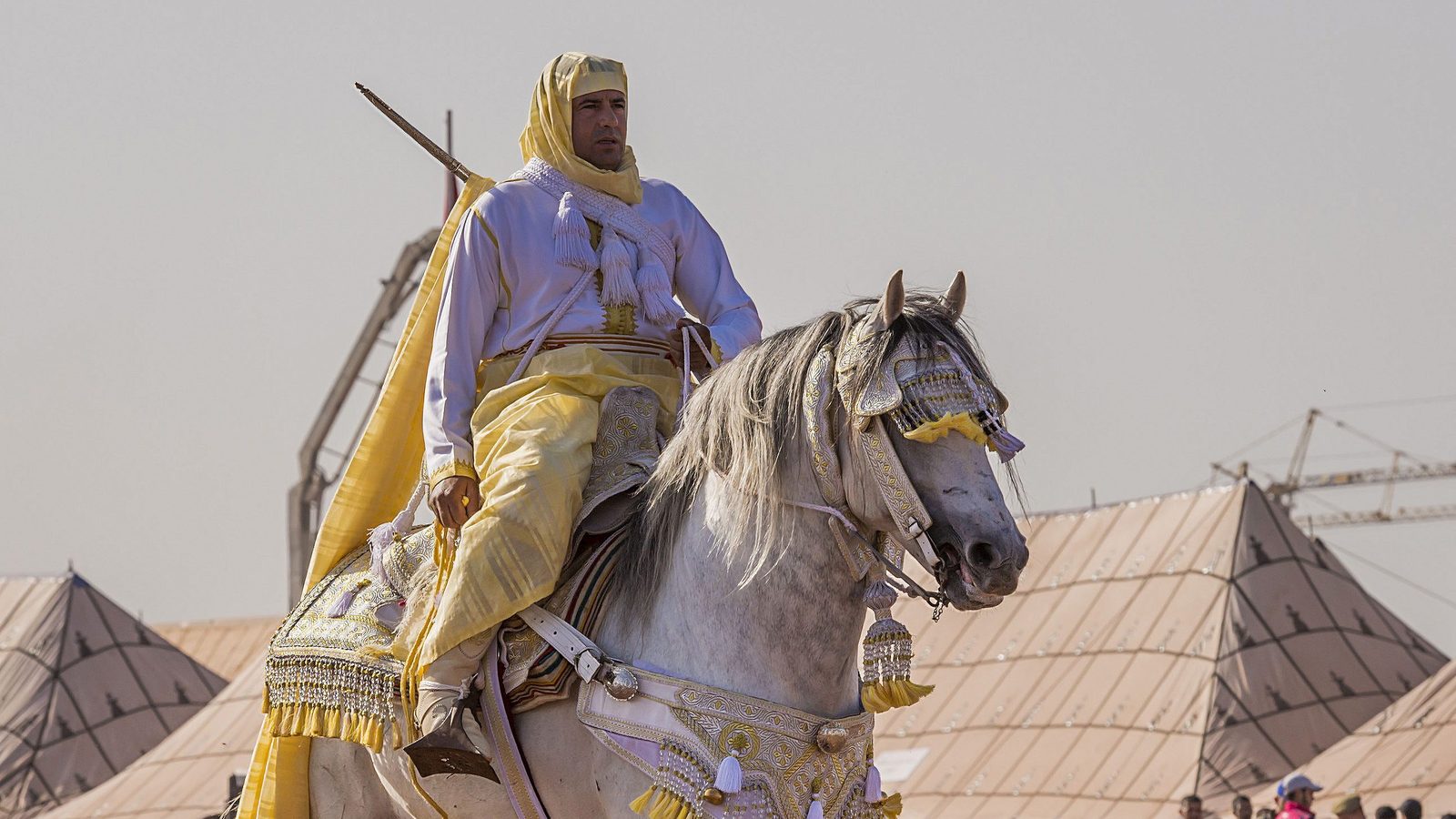
Horses, saddles and the musket
- The horses are mostly Barb or Arab-Barb, chosen for their stamina, calm and quick acceleration — see our guide to the Barb horse.
- The saddle (sarj) has a high front and back, sits on several layers of saddle cloths and is covered in embroidery, often with silver or gold thread. Matching bridle and breastplate complete the outfit.
- The musket (mkahla) is long and slim, often inlaid with silver, bone or mother-of-pearl, and loaded with black powder only — no bullet.
The rider's costume
Riders wear a white jellaba or robe, a selham (a wide cloak), a turban, soft leather riding boots and a curved dagger, the koumia, on a cord across the chest. Each region has its own touches — colours, the way the turban is tied, the decoration of the saddle — and fans can often tell where a sorba comes from before it reaches the track.
How a tbourida is judged
In competitions, judges look at:
| Criterion | What they want |
|---|---|
| The volley | One single detonation, no staggered shots |
| The line | Riders aligned from start to finish |
| The departure | All horses leaving at the same moment |
| The salute | Elegance and discipline before the run |
| The presentation | Horses, saddles and costumes in good order |
The most prestigious competition is the Hassan II Trophy for traditional equestrian arts, whose final is held at Dar Es-Salam in Rabat; the 25th edition was decided in June 2026. Big shows also take place at the Moussem of Moulay Abdellah Amghar and at the Salon du Cheval in El Jadida. Women's sorbas now compete too — read about female tbourida.
Watching tbourida near Essaouira
The easiest fantasia to reach from the coast in 2026 is the Moussem Sidi El Mokhtar, from 22 to 25 October, on the road between Marrakech and Essaouira. A private driver is the simplest way to go and come back after the last passage: add a stop to our Marrakech to Essaouira transfer or to the Essaouira to Marrakech transfer, or ask us for a custom afternoon from Essaouira, in the style of our full-day private excursion.