There are few subjects as photogenic — and as unforgiving — as a tbourida. The riders gallop towards you at full speed, the decisive moment lasts a fraction of a second, and a second later everything disappears in a cloud of white smoke. If you want to photograph a fantasia and come home with more than blurry dust, a little preparation goes a long way.
These tips come from our drivers, who take photographers to moussems every season, and from the photographers themselves.
Where to stand to photograph a fantasia
The track, or mahrak, is a long earth strip, often two to three hundred metres long. The horses start at one end, gallop and fire their muskets towards the far end.
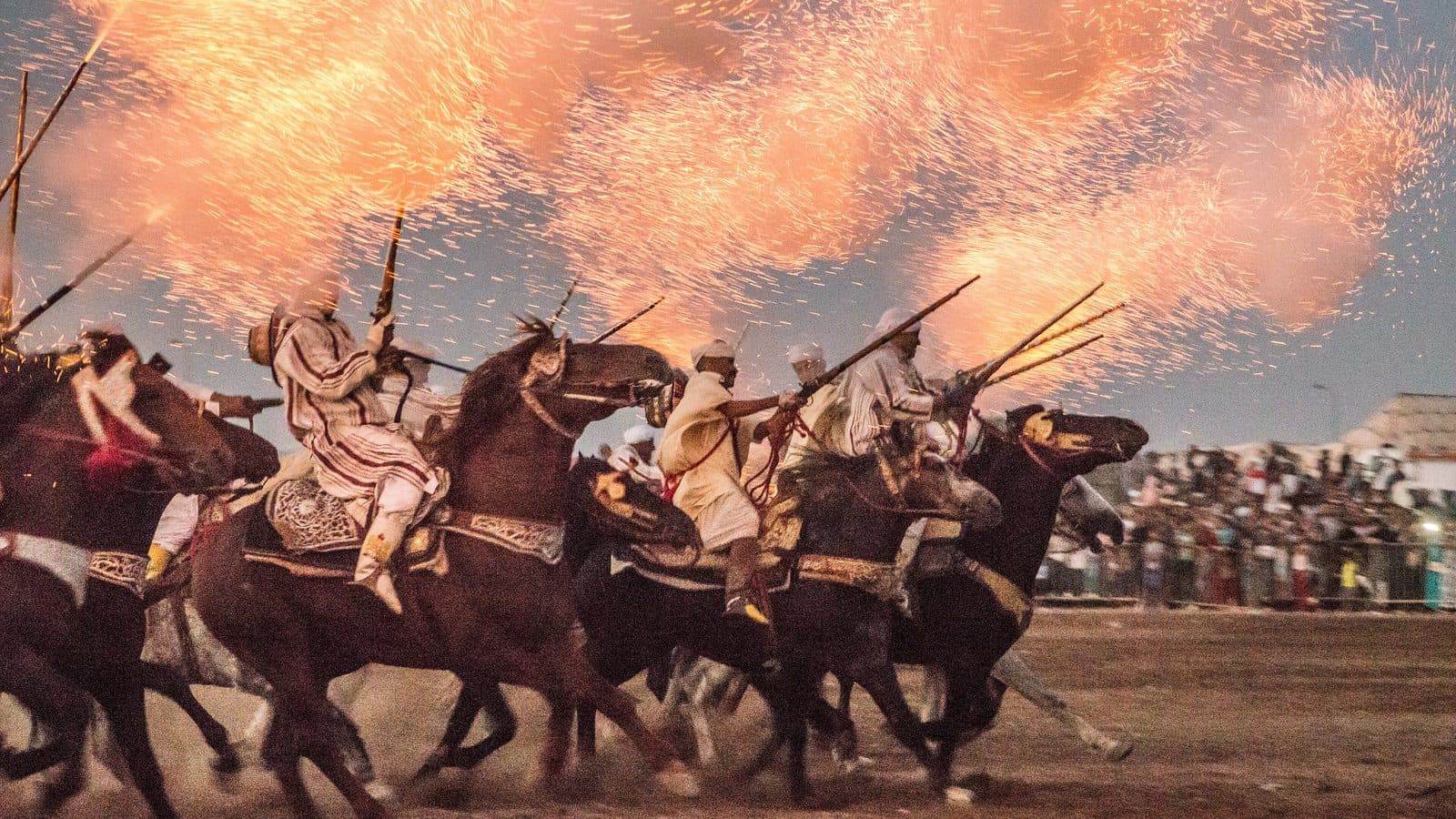
- Stand on the side, about two-thirds of the way down the track. That is where the line is fully formed and the riders fire. You get the horses at a slight angle, which shows the whole line.
- Never stand at the very end of the track or in front of it, even if others do. The horses pull up there, and it is the noisiest place.
- Look at the wind. Stand upwind, so the smoke blows away from you instead of covering the riders.
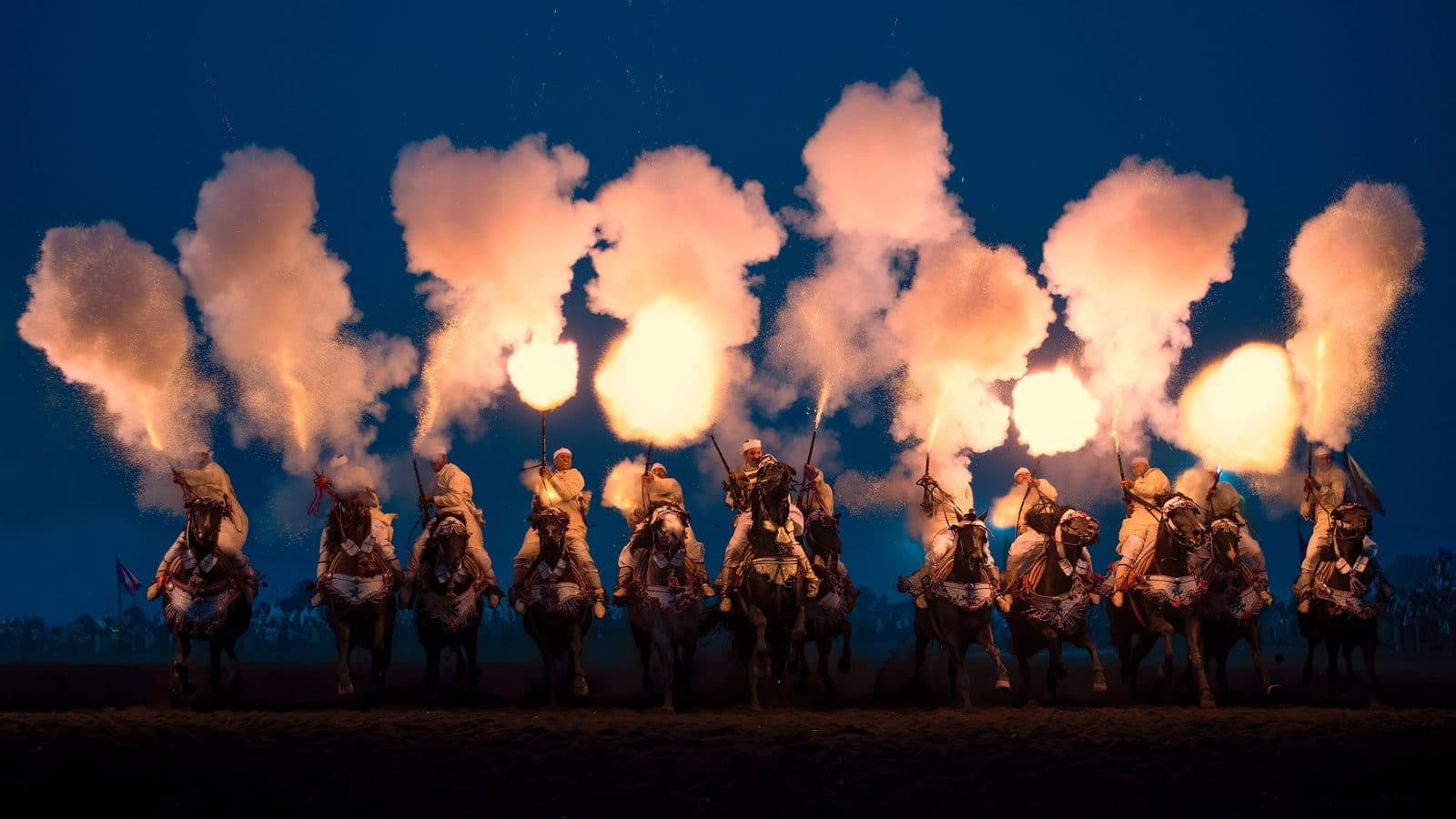
- Check the sun. In the late afternoon, with the sun behind you, the colours of the saddles glow; shooting into the sun gives dramatic silhouettes and backlit smoke.
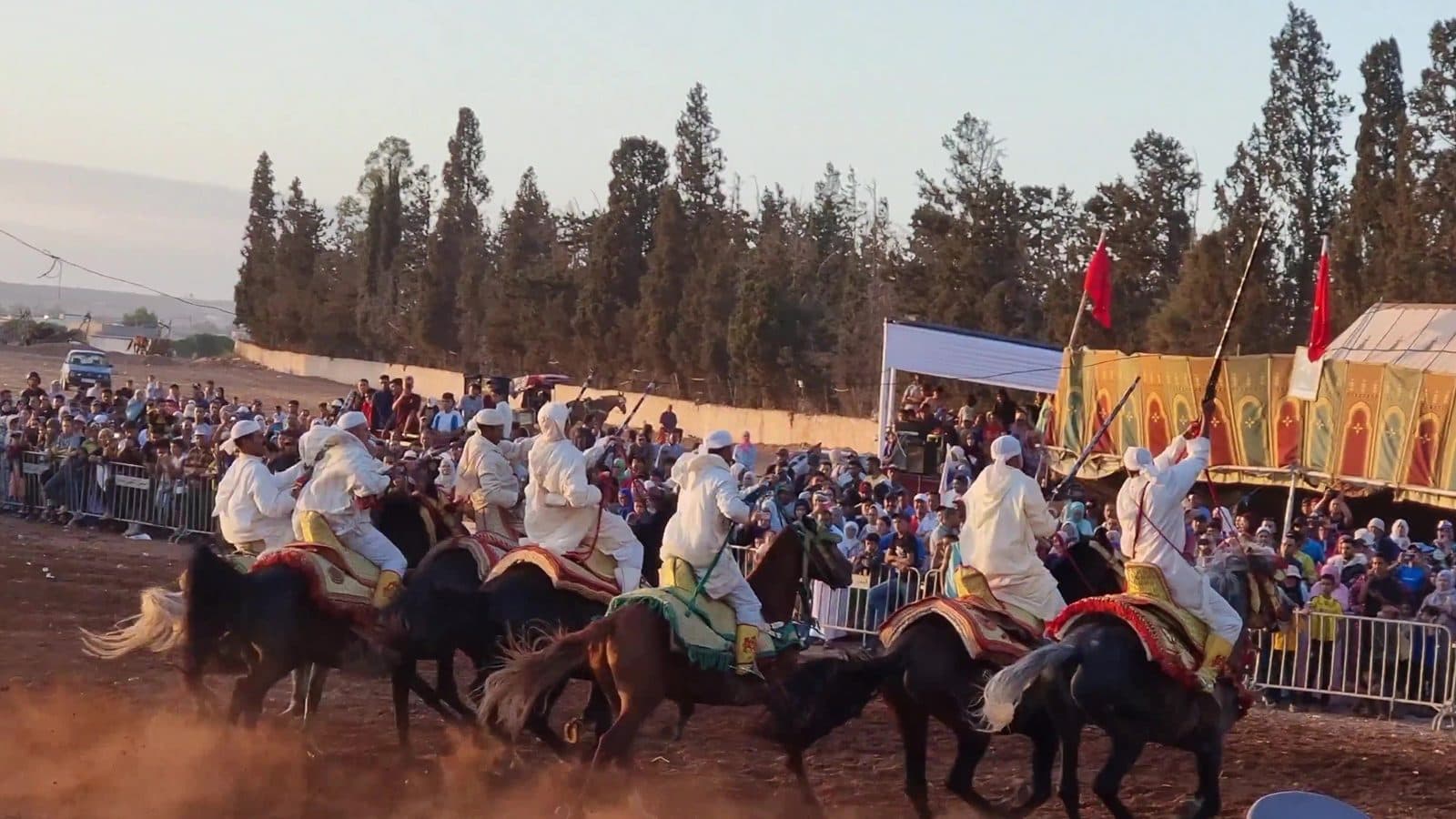
- Grandstands help. A raised position lets you shoot over the heads of the crowd and includes the track and the tents in one frame.
Camera settings
- To freeze the action: a shutter speed of 1/1000 s or faster, aperture f/4–f/5.6, auto ISO.
- For movement: try panning at 1/60–1/125 s, following one rider; the background streaks and the horse stays relatively sharp. Expect many misses — and a few great frames.
- Autofocus: continuous mode (AF-C / AI Servo) with a wide or tracking area. Or pre-focus on the spot where the riders usually fire.
- Burst mode: the volley lasts an instant; shoot a burst a fraction of a second before the leader's cry.
- Lenses: a 70–200 mm is ideal from the side of the track; a wide-angle lens is perfect for the atmosphere of the fair, the tents and the crowd.
With a phone, use burst mode (hold the shutter), avoid digital zoom and try slow-motion video: a tbourida volley in slow motion is spectacular.
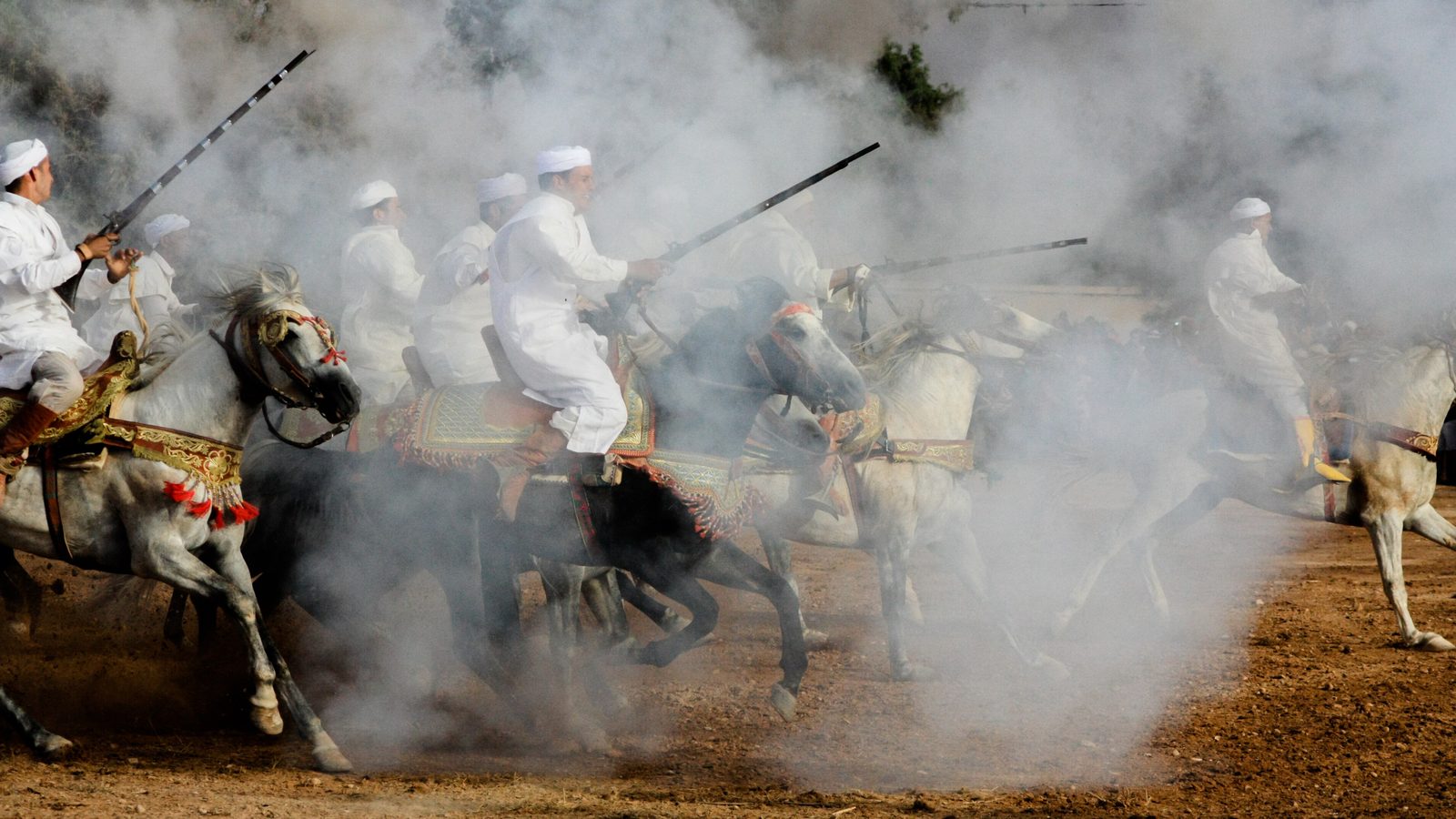
Timing the volley
Watch the leader in the middle of the line, not the whole line. The riders raise their muskets, the leader shouts, and the shot follows almost immediately. After a few passages you will feel the rhythm of each troupe. In the last hour before sunset, the flash of the black powder becomes visible — that is when the most striking images are made, like the night volley on our fantasia guide.
Dust, smoke and your equipment
- Avoid changing lenses near the track; dust gets everywhere. Bring two bodies or one zoom.
- Use a UV or protective filter and keep a blower and microfibre cloth in your pocket.
- A rain cover or a simple plastic bag protects the camera when the wind lifts the dust.
- A scarf for you, too: on windy days the dust is constant.
- Leave the drone at home. Flying a drone in Morocco requires official authorisation, and drones are often confiscated at customs.
Portraits: photograph people with respect
The best fantasia pictures are often portraits: a rider adjusting his turban, a child on his father's shoulders, an old man watching from a tea tent.
- Ask first. A smile and a gesture towards the camera are usually enough. Riders are proud of their horses and outfits and often happy to pose before or after their passage — not just before the start, when they need to concentrate.
- Be careful with women and families. Many prefer not to be photographed; respect a "no".
- Do not photograph pilgrims at prayer or inside the shrine.
- Show the picture on your screen afterwards; it often opens a conversation — and sometimes an invitation for tea.
Our guide to what a moussem is explains the etiquette in more detail.
The best events to photograph a fantasia
- Moussem Sidi El Mokhtar, 22–25 October 2026, on the Marrakech–Essaouira road: a regional moussem with an authentic atmosphere and soft autumn light.
- Moussem of Moulay Abdellah Amghar, every August near El Jadida: the biggest gathering, with more than a hundred troupes.
- The Salon du Cheval in El Jadida, in October, and the Tan-Tan moussem, with camel riders and Saharan tents.
- Fantasia dinner shows near Marrakech for night shots under floodlights — see fantasia show in Marrakech.
Getting there with your gear
Photographers need time on site and a safe place to leave a spare bag. A private driver gives you both: the car stays nearby, you choose when to leave, and you are not carrying tripods in a crowded grand taxi at night. Add a stop at Sidi El Mokhtar to our Marrakech to Essaouira transfer (from €90 per vehicle at the time of writing) or to the Essaouira to Marrakech transfer. Staying on the coast? Combine the fantasia with golden-hour landscapes on our private picnic excursion — and contact us to plan the timing around the light.