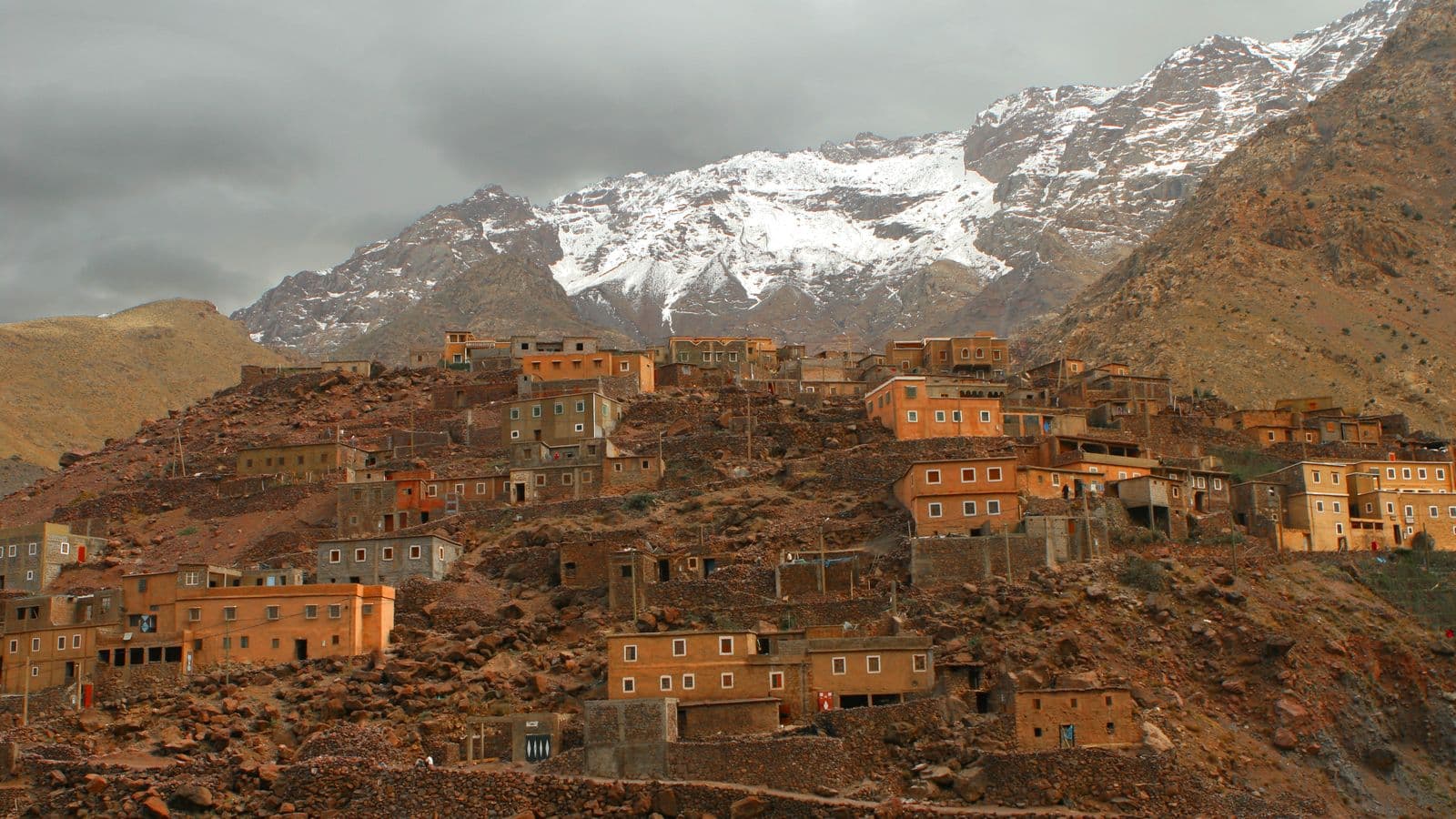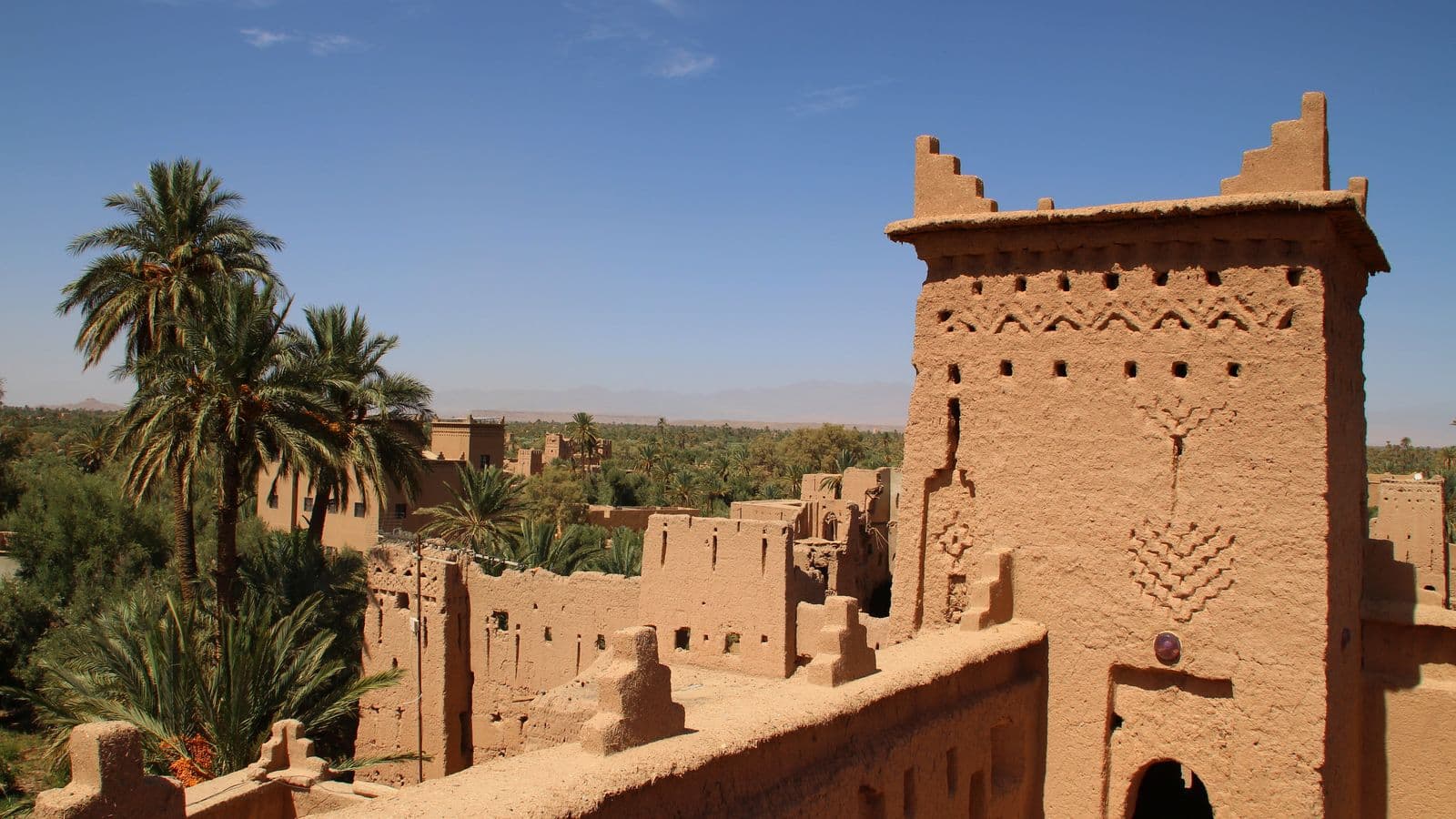
East of Ouarzazate, the road towards Tinghir and the Sahara runs along a chain of oases at the foot of the High Atlas. Every few kilometres, a tower of ochre earth rises above the palms, decorated with geometric patterns and crowned with crenellations; around it, whole villages of earth houses cluster like fortresses. This is the road of a thousand kasbahs, one of the great journeys of southern Morocco, and the backdrop to all our desert circuits.
Here is our guide to the kasbahs: what they are, how they were built and which ones to see.
Kasbah, ksar, tighremt: what is the difference?
- A kasbah is a fortified house or castle, usually belonging to a powerful family or a local chief (caïd), with high walls and corner towers.
- A ksar (plural ksour) is a fortified village: a cluster of houses, a mosque, a granary and lanes enclosed within one wall, with a single gate.
- A tighremt is the Amazigh word for a fortified family house, often with four towers.
In everyday language, travellers and guides use "kasbah" for all of them.
How were kasbahs built?
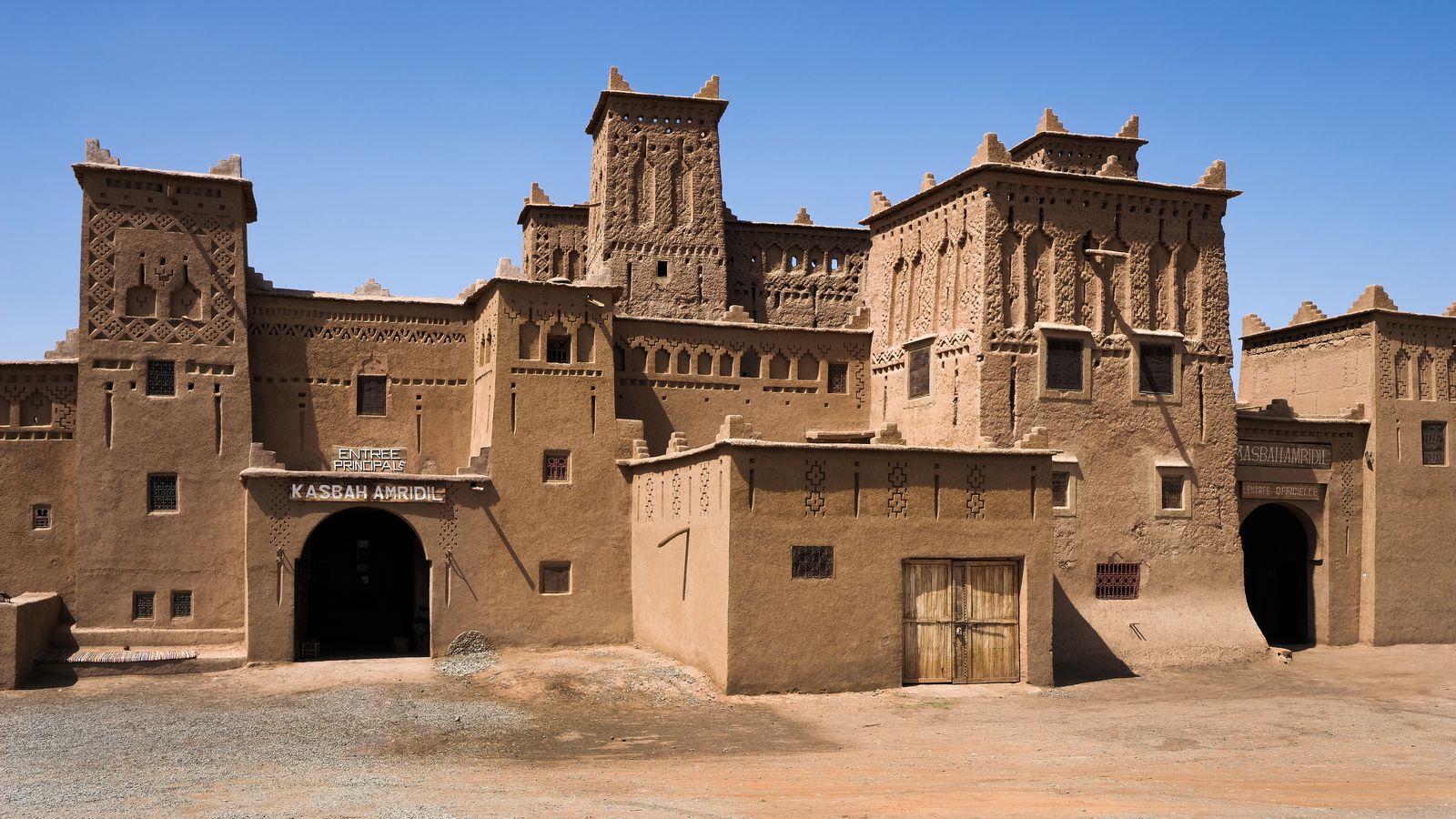
Kasbahs are made of rammed earth (pisé): a mixture of clay, gravel and straw packed between wooden boards, layer by layer, to form thick walls that keep the interior cool in summer and warm in winter. Upper floors and decorations often use sun-dried mud bricks, and ceilings are made of palm trunks, cane and tamarisk branches. The geometric motifs carved into the towers are both decoration and identity, inherited from Amazigh traditions.
The weakness of earth is water: without regular maintenance, rain slowly dissolves the walls, which is why so many kasbahs are now romantic ruins. In Ouarzazate, a centre dedicated to earthen architecture works on their study and restoration, and many have been brought back to life as guesthouses.
Who built the kasbahs?
For centuries, the oases of the South were crossroads of the caravan trade between the Sahara and the cities of the north. Families who controlled water, land and trade routes built kasbahs to protect their harvests, their animals and their people from raids. In the early 20th century, the Glaoui family rose to dominate much of the region from Telouet and Ouarzazate, and many of the grandest kasbahs on the road of a thousand kasbahs date from that era. With the end of the caravans and the arrival of modern houses, many families left their earth fortresses — which is why some stand empty today.
The kasbahs not to miss
Taourirt, Ouarzazate
Once a residence of the powerful Glaoui family, the kasbah of Taourirt sits in the heart of Ouarzazate. Part of it can be visited, with painted ceilings and small rooms around courtyards. Our Ouarzazate guide has the details.
Kasbah Amridil, Skoura
In the middle of the Skoura palm grove, Amridil is one of the best-preserved kasbahs in Morocco, dating back to the 17th century and once pictured on a Moroccan banknote. A family still looks after it, and the visit shows the stables, the olive press, the kitchens and the rooftop views over the palms.
Kelaat M'Gouna and the Dades
Beyond Skoura, the road enters the Valley of Roses around Kelaat M'Gouna, then follows the Dades river, lined with kasbahs perched on rocky spurs. Our Dades valley guide describes the best viewpoints.
Telouet and Aït Ben Haddou
North-west of Ouarzazate, two more icons complete the picture: Telouet, the original stronghold of the Glaoui, whose painted salons are breathtaking, and Aït Ben Haddou, the UNESCO-listed ksar seen in many films. See our guides to Telouet and Aït Ben Haddou.
N'Kob and the Draa valley
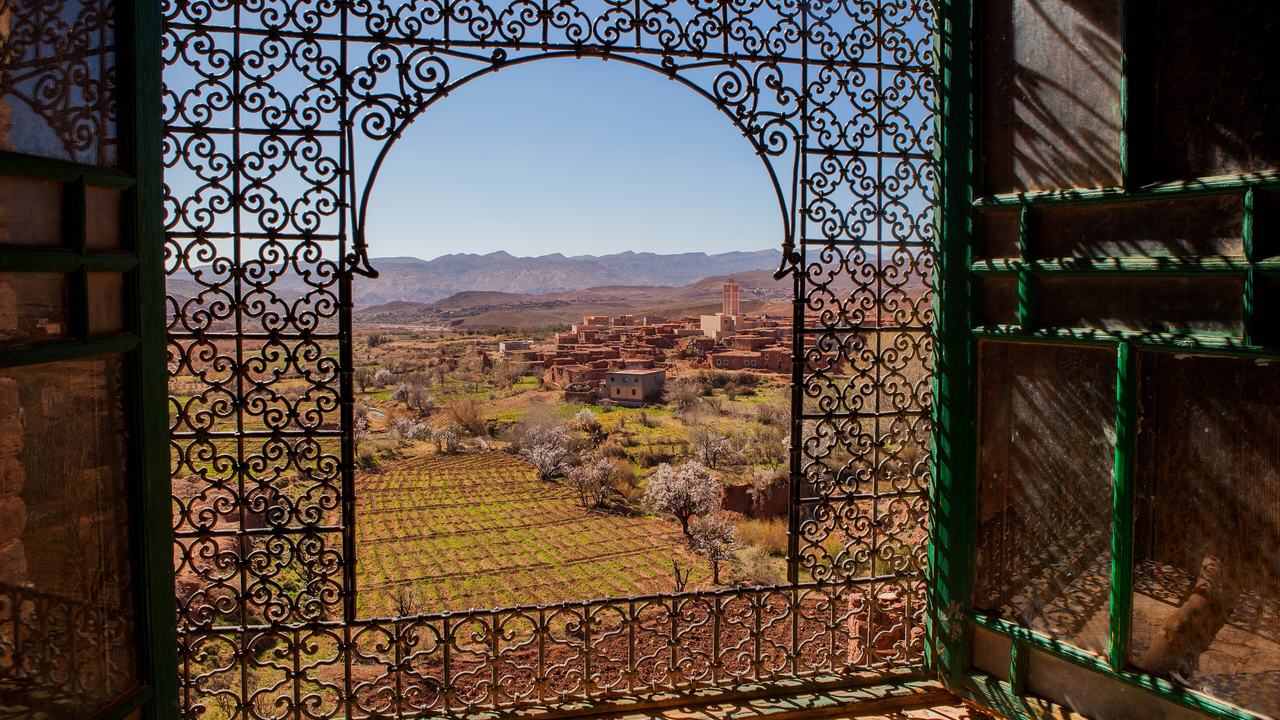
South of the Jebel Saghro, the village of N'Kob has dozens of kasbahs, and the Draa valley is lined with ksour such as Tamnougalt near Agdz. These are on the return route of our 5-day loop — see our Draa valley guide.
How to see the road of a thousand kasbahs
The most rewarding way is slowly, with stops: a walk in the Skoura palm grove, a visit to Amridil, tea in a kasbah guesthouse, a photo stop at each viewpoint. All our desert circuits follow at least part of the route:
- The 4-day Merzouga tour passes Skoura, Kelaat M'Gouna and the Dades on day one.
- The 5-day Grand South loop devotes a relaxed day to Skoura and the Valley of Roses, and returns via N'Kob and the Draa.
- The 7-day grand tour adds Telouet and a night in Aït Ben Haddou.
Sleeping in a kasbah
Many restored kasbahs and ksour now welcome guests: thick earth walls, rooftop terraces, courtyards and palm groves on the doorstep. It is one of the most atmospheric ways to experience the South. Our guide to where to stay in southern Morocco explains what to expect and how we choose them.
Tips for visiting kasbahs
- Bring a torch for dark interior rooms and stairways.
- Some kasbahs are private homes: ask before entering and leave a small contribution if a family shows you around.
- The light is most beautiful in the early morning and at the end of the afternoon.
- Respect fragile walls: do not climb on ruins.
Ready to follow the road of a thousand kasbahs? Send us your dates on WhatsApp, or compare every route in our guide to multi-day tours from Marrakech.